
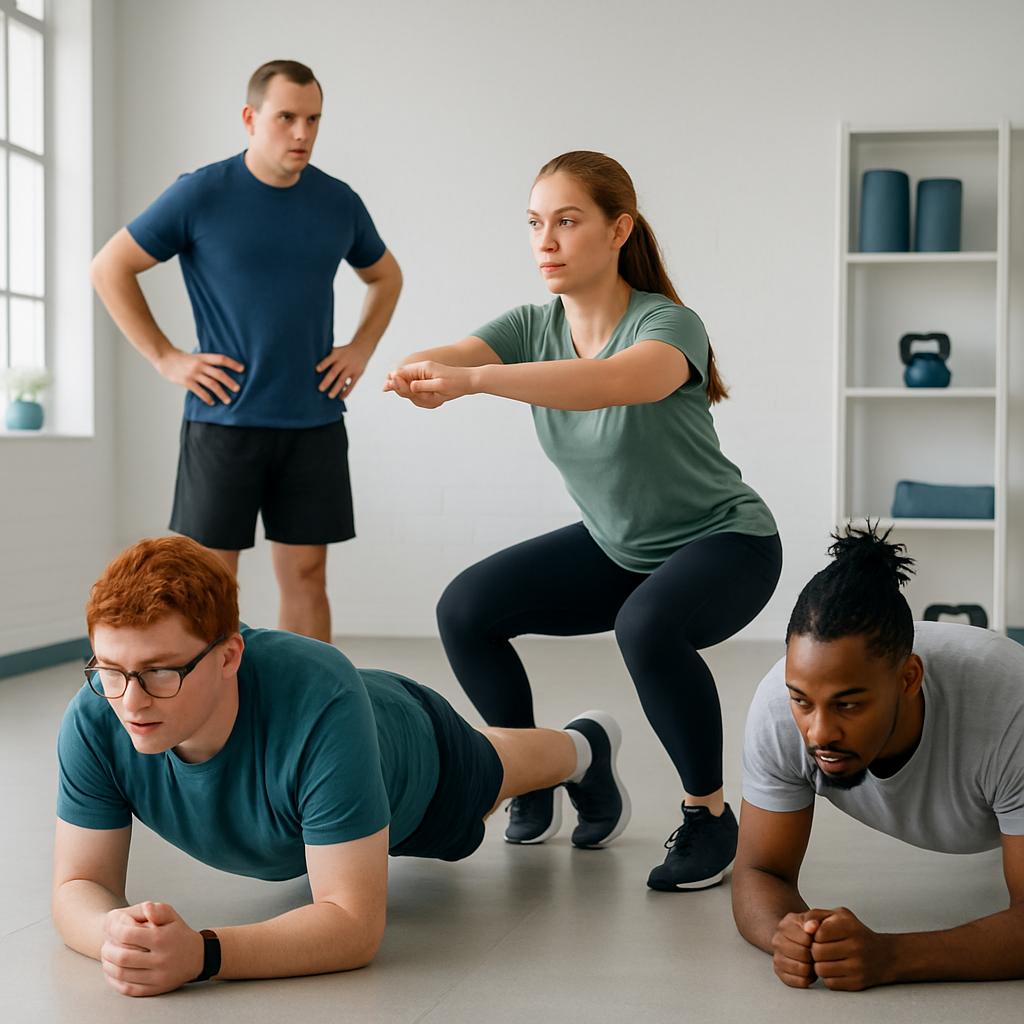
Understanding the Unique Challenges
The path to bodyweight mastery requires special consideration for neurodiverse athletes. Children with autism face a 12% higher injury risk during physical activities, and these patterns often persist into adulthood without proper training adaptations.
Critical Safety Statistics
- Children under 15 with autism have injury death rates 42 times higher than neurotypical peers
- The injury incidence rate is 32.3% among autistic individuals
- Young children with ASD show a hazard ratio of 1.282 for injuries
Ninja Tip: Start with a detailed body awareness assessment before attempting advanced movements.
The NinjaFitness Neurodiverse Protocol
Phase 1: Proprioceptive Foundation
Build body awareness through these progressive steps:
- Wall-Based Alignment
- Start with wall pushes
- Progress to wall handstands
- Focus on pressure sensitivity
Ninja Tip: Use tactile markers (grip tape strips) on the wall to provide consistent sensory feedback.
Phase 2: Scapular Mastery
Higher upper-body injury risks from poor body awareness make shoulder control crucial:
- Scapular pulls
- Dead hangs with activation
- Band-assisted retractions
Ninja Tip: Practice scapular control drills before every session, not just during warm-up.
Phase 3: Core Integration
Address coordination challenges noted in injury data:
- Hollow body progressions
- RKC planks
- Dragon flag negatives
Ninja Tip: Use breathing patterns (4-count inhale, 6-count exhale) to enhance mind-muscle connection.
Sensory-Smart Training Environment
Visual Guides
Create a distraction-minimized training zone:
- Solid-colored walls
- Consistent lighting
- Clear movement zones
Ninja Tip: Mark your training area with colored tape to define movement boundaries.
Tactile Considerations
- Textured grip surfaces
- Consistent equipment placement
- Temperature-controlled environment
Progressive Skill Development
Level 1: Foundation (Weeks 1-4)
- Wall pushups: 3×5-10
- Supported squats: 3×8-12
- Hanging scapular pulls: 3×5
Level 2: Intermediate (Weeks 5-12)
- Regular pushups: 3×8-12
- Free squats: 3×12-15
- Active hangs: 30-60 seconds
Level 3: Advanced (Weeks 13+)
- Diamond pushups: 3×8-12
- Pistol squat progressions
- Pull-up negatives: 3×3-5
Recovery and Regulation
Sensory processing challenges can increase injury risk. Implement these recovery strategies:
- Deep pressure techniques
- Proprioceptive input exercises
- Structured cool-down routines
Ninja Tip: Keep a sensory regulation toolkit nearby during training sessions.
Advanced Movement Preparation
Before attempting skills like the Planche or Front Lever:
- Master scapular depression
- Develop wrist mobility
- Build core tension awareness
Ninja Tip: Record and analyze movement patterns to identify compensation strategies.
Join the Neurodiverse Ninja Community
Ready to master bodyweight skills with proper progression? Join our specialized training program designed for neurodiverse athletes. We offer:
- Sensory-smart programming
- Progressive skill development
- Community support
Sign up for our Neurodiverse Ninja program today and start your journey to safe, effective bodyweight mastery.
Leave a Reply