
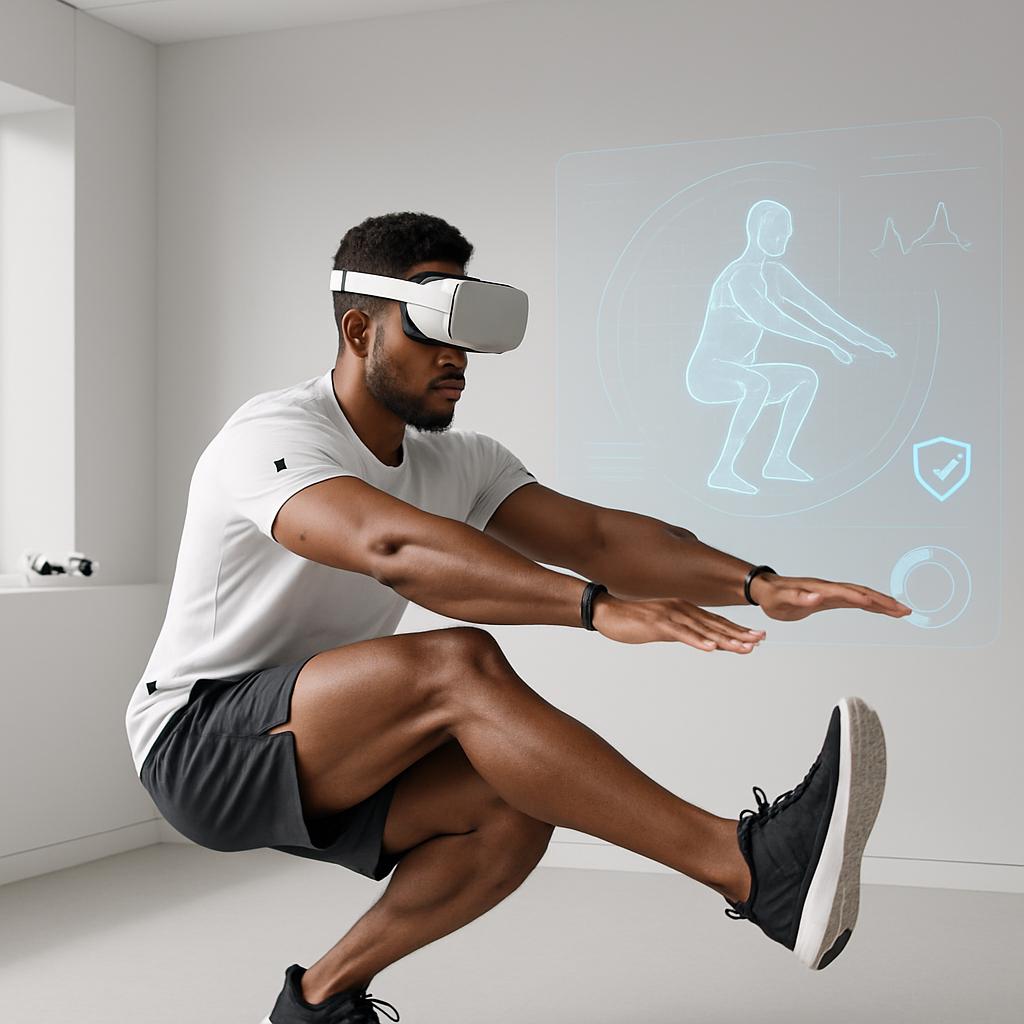
The Evolution of Movement Mastery
Traditional bodyweight training is receiving a cutting-edge upgrade. Virtual Reality is not only changing how we train – it’s revolutionizing the mastery of complex movement patterns and enhancing injury prevention.
The Science Behind VR Training Success
Enhanced Injury Prevention
VR training reduces pain scores significantly in ACL patients, outperforming traditional methods at 4 weeks, 8 weeks, and 6 months post-intervention.
Ninja Tip: Use VR feedback to perfect your landing mechanics before attempting advanced plyometric movements.
Superior Balance Development
Virtual reality improves all major stability indices including overall stability (OASI), antero-posterior stability (APSI), and medio-lateral stability (MLSI).
Ninja Tip: Integrate VR balance training before progressing to single-leg skills like pistol squats.
Biomechanical Optimization
Scapular Control
Athletes show improved shoulder mechanics and stability when using VR for upper body movement patterns.
Ninja Tip: Use VR feedback to perfect scapular positioning before attempting advanced pulling movements.
Lower Body Mechanics
VR monitoring of ground reaction forces helps optimize squat patterns and landing mechanics.
Ninja Tip: Practice VR-guided jump landings to build a foundation for explosive movements.
Advanced Application Strategies
Skill Progression Protocol
Research shows VR enhances motor learning through real-time feedback, making it ideal for complex skill acquisition.
- Basic Movement Pattern Analysis
- Real-time Form Correction
- Progressive Loading
- Skill Transfer Testing
Risk Management
UNC researchers demonstrate reduced injury risk through VR-based movement assessment and correction.
Implementation Guide
Getting Started
- Invest in a quality VR system compatible with fitness applications
- Begin with basic movement pattern analysis
- Progress to skill-specific training modules
- Monitor metrics for continuous improvement
Advanced Integration
- Use VR for warm-up movement pattern assessment
- Implement virtual spotting for high-risk movements
- Track longitudinal progress through data analytics
Benefits of VR Fitness for Bodyweight Training
Virtual reality (VR) is revolutionizing the fitness industry by enhancing traditional bodyweight workouts. Athletes can immerse themselves in virtual environments, engaging in exercises that maximize muscle activation and improve coordination. For instance, VR can transform routine push-ups and squats into interactive, gamified experiences that maintain motivation and consistency. Research shows that VR workouts can achieve a calorie burn comparable to high-intensity interval training (HIIT), fostering both strength and endurance. Ninja Tip: Use VR to practice complex bodyweight movements like handstands in a controlled environment, reducing the risk of injury. Sources: FXM Web, Draw and Code.
The Future of Training
Virtual reality platforms are revolutionizing athletic development by combining engaging gameplay with precise movement analysis.
Ready to elevate your training? Join the NinjaFitness VR Training Program and access our exclusive virtual movement optimization protocols.
#TrainSmarter #NinjaFitness
Leave a Reply